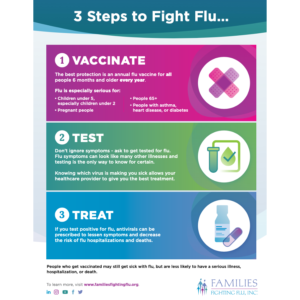
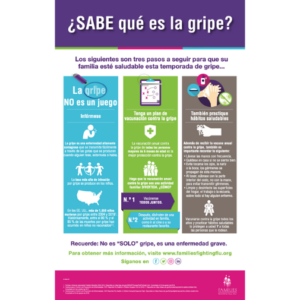
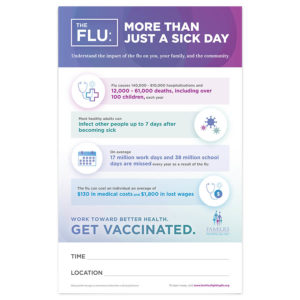
Our educational materials and social media graphics are available as free downloadable files and can also be ordered as hard copy materials for doctors’ offices, healthcare clinics, schools, and other important places within your community.
Sign up for our Weekly Flu News and quarterly newsletter, Fighting Influenza, to stay up-to-date on the latest flu news.
LOGO LICENSE AGREEMENT
You are required to accept all of the terms and conditions in this License Agreement in order to receive a limited, non-exclusive, non-transferable, non-assignable, royalty-free license to use the FAMILIES FIGHTING FLU, INC. logo, displayed below (the “FFF Logo”), from Families Fighting Flu, Inc. (“FFF”). In order to accept these terms and conditions, you must click the “I Accept” button below.
FFF hereby grants to you, and you accept, a limited, non-exclusive, non-transferable, non-assignable, royalty-free license to use the FFF Logo, which you may download and use solely in online and print earned media publications for a period of no more than six (6) months in the United States.
You acknowledge that the FFF Logo is a valid trademark; that FFF is the sole owner of the FFF Logo; and that FFF retains all right, title, and interest in and to the FFF Logo. You agree that any and all use that you make of the FFF Logo, and any and all goodwill arising from your use of the FFF Logo, shall inure exclusively to the benefit of FFF. You also agree that you shall not challenge the validity of the FFF Logo or FFF’s ownership or title thereto during the term of the License Agreement or thereafter.
You agree that you shall use the FFF Logo only in the form shown above, and that you shall not alter, modify, change, or edit the FFF Logo in any manner.
You acknowledge the valuable goodwill and reputation in the FFF Logo, and that it is essential that the high standards and reputation associated with the FFF Logo be maintained. You therefore agree to use the FFF Logo consistent with the highest standards of quality so as to protect and maintain the FFF Logo and FFF’s rights therein.
FFF shall have the right to review and inspect your use of the FFF Logo at any time. FFF, in its sole discretion, may determine that you are not using the FFF Logo in an acceptable manner and require that you discontinue your use of the FFF Logo. To the extent that FFF requires that you discontinue your use of the FFF Logo, you agree that you shall remove the FFF Logo from all online and print earned media publications as soon as practicable under the circumstances, and that you shall not use the FFF at any time in the future.
You must include the following notice in connection with any use of the FFF Logo: “The Families Fighting Flu, Inc. logo is the registered trademark of Families Fighting Flu, Inc.”